
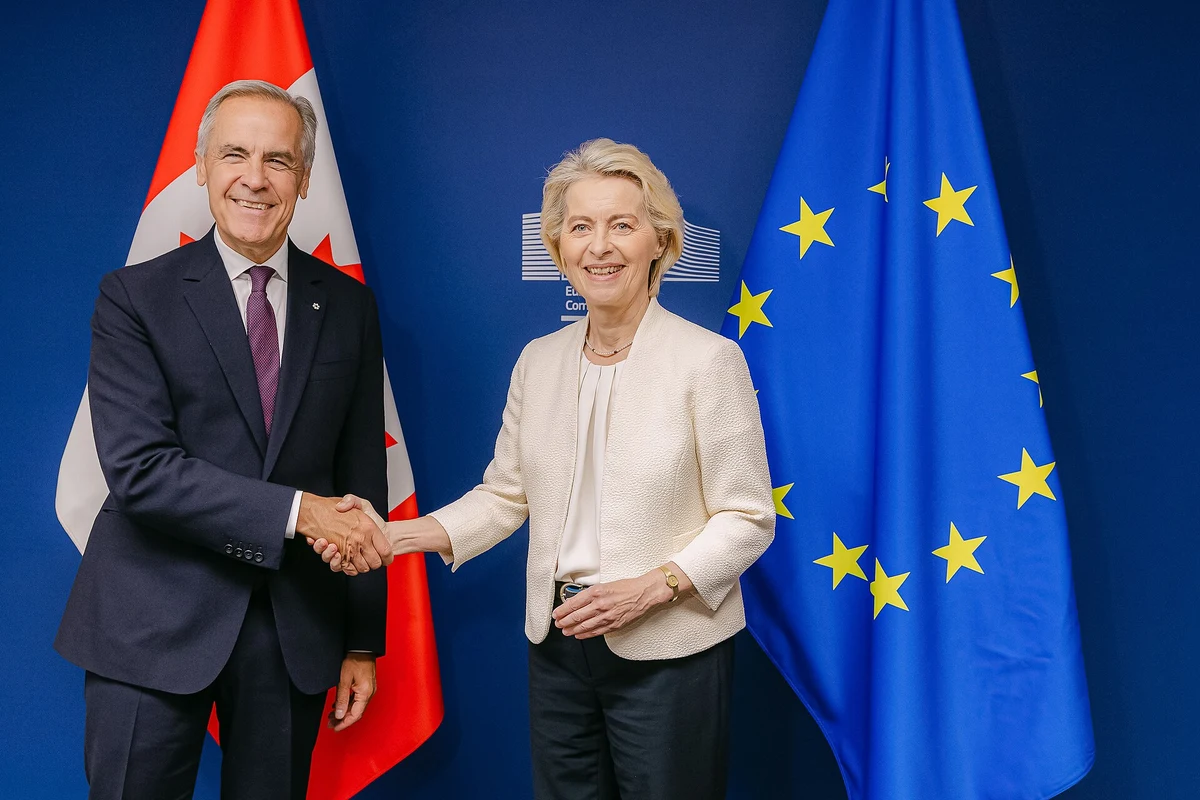
OTTAWA - Prime Minister Mark Carney will host the Canada-European Union Summit in Montreal from October 29 to 30, 2026, meeting European Council President António Costa and European Commission President Ursula von der Leyen to turn a fast-deepening partnership into concrete results on trade, defence and youth mobility, the Prime Minister’s Office announced on October 25.
Canada and the European Union (EU), the bloc of 27 European countries that acts as one market for trade, have spent the past year and a half building what both sides call an ambitious new partnership. The Montreal summit is where that partnership is expected to move, in the Prime Minister’s words, from ambition to action.

Ottawa says the summit’s goals are more choice and lower costs for consumers, new export markets for businesses, and greater opportunities for young people to live, work and study where they want, in Canada or in the EU. The EU brings market power, research depth and manufacturing strength. Canada brings abundant energy, critical minerals, world-class capabilities in space, artificial intelligence (AI) and quantum technology, and one of the world’s strongest banking systems.
“The world is more dangerous and divided. In response, Canada and the European Union are building on each other’s strengths, deliberately, systematically, and rapidly, to form a new, ambitious alliance,” Carney said. “An alliance strong enough so that no one can dictate our choices, and an alliance open enough that others can join.”
Why this matters to Surrey
Surrey sits at the centre of Metro Vancouver’s trade and logistics economy. The city’s industrial districts, including Campbell Heights, Port Kells and Newton, are packed with warehousing, trucking, freight and distribution businesses, many of them family-run import and export operations. Europe is a key source and destination market for the goods those businesses move, from machinery and auto parts to pharmaceuticals, wine and specialty foods.
Under CETA, the Comprehensive Economic and Trade Agreement between Canada and the EU that has applied since 2017, nearly all European goods already enter Canada tariff-free and Canadian exporters get the same access in reverse. A deeper Canada-EU partnership could widen that opening for B.C. exporters of lumber, seafood, agrifood products and technology services, and any new measures on consumer prices or business costs will be watched closely by Surrey’s trading community.
The youth mobility piece matters here too. Surrey is one of the youngest cities in B.C., home to Simon Fraser University’s Surrey campus and Kwantlen Polytechnic University. Expanded opportunities for young Canadians to live, work and study in Europe, and for young Europeans to do the same in Canada, would land directly on Surrey students and young professionals weighing their next move.
Defence is the third Surrey angle. The first contract won through Canada’s new European defence channel went to a Montreal company building tactical radios for Poland. As EU defence procurement opens to Canadian firms, B.C.’s technology and manufacturing suppliers, including the aerospace and tech cluster across Surrey and Langley, will be watching the summit for procurement announcements they can bid on.
A partnership built in 18 months
The Montreal summit builds on the New EU-Canada Strategic Partnership of the Future and the Security and Defence Partnership, both launched at the last Canada-EU Summit on June 23, 2025, in Brussels, Belgium.
Since then, the milestones have come quickly. In February 2026, Canada became the first non-European country to join SAFE, the EU’s Security Action for Europe initiative, which coordinates European defence purchasing and has unlocked hundreds of millions of dollars in opportunities and market access for Canadian defence industries, businesses and workers. In May 2026, Carney became the first non-European leader to take part in the European Political Community Summit, held in Armenia. In June 2026, Canada announced the first procurement secured through SAFE: Montreal-based Marconi Technologies will build made-in-Canada ORION tactical radios for the Polish Cyber Command. Last month, Carney addressed the European Parliament in Strasbourg, France, where he set out his vision for a new alliance for the future.
The numbers behind the relationship
- The Canada-EU relationship is the oldest formal relationship the EU has with any industrialised country, dating back to 1959.
- The EU is Canada’s second-largest global trading partner for goods and services, worth approximately $178 billion in 2025.
- The EU is also Canada’s second-largest source of foreign direct investment (FDI), meaning money invested into Canadian businesses and projects, after the United States. EU investment stock in Canada was estimated at $219 billion in 2025, while Canadian direct investment in the EU totalled $315 billion.
- The last Canada-EU Summit was held on June 23, 2025, in Brussels.
Leaders are expected to issue a joint statement at the close of the summit on October 30. Apna News will follow the Montreal meetings and update this story with any agreements affecting trade, prices, defence contracts and youth mobility for Surrey readers.
Source: Prime Minister of Canada news release, “Prime Minister Carney to host Canada-European Union Summit in Montréal to advance an ambitious new Canada-EU partnership,” October 25, 2026.