
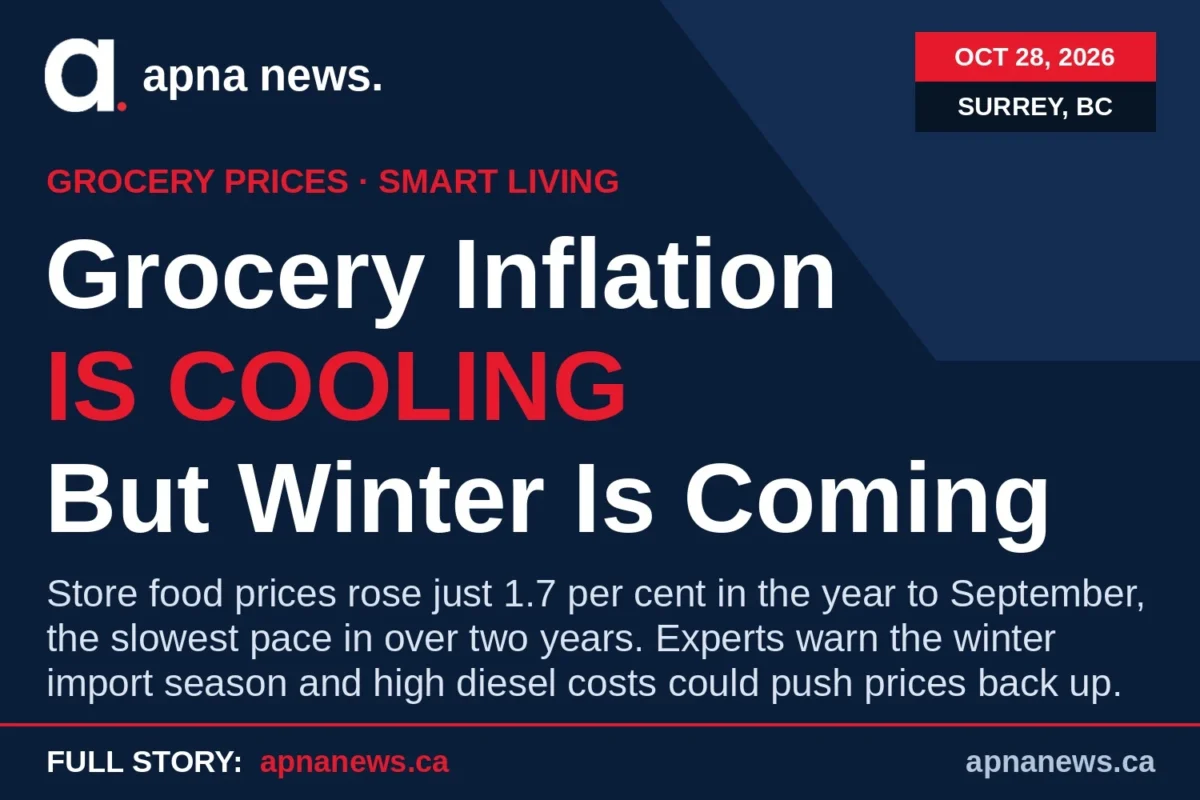
SURREY, B.C. - There is finally some relief in the grocery aisle: the price of food bought from stores rose just 1.7 per cent in the year to September 2026, the slowest pace in more than two years, according to Statistics Canada. But food economists are warning Surrey families not to bank on the relief lasting, because the winter import season and a sharp rise in diesel costs could push grocery prices back up in the months ahead.
The warning, from food experts and economists who spoke to The Canadian Press on October 9, rests on two pressures. The first is diesel: Statistics Canada’s food supply-chain data shows diesel prices were up 75 per cent year over year in August 2026, and diesel moves almost every box of food in the country. “As diesel prices go up, food prices go up relatively across the board,” said Mike von Massow, a food economist at the University of Guelph, who said fresh food that travels long distances or needs refrigeration is the most exposed.

What the latest numbers say
Statistics Canada’s September consumer price index, released October 19, shows grocery price growth cooling for a second straight month, down from 2.8 per cent in August. Fresh vegetables were 2.9 per cent cheaper than a year earlier, and sugar and confectionery fell 2.7 per cent. Not everything is easing: fresh and frozen beef was still up 8.7 per cent year over year, although that is down from 11.0 per cent in August.
The longer view is less comforting. Even with the recent cooling, Canadians are paying 33.0 per cent more for groceries than they did in September 2020, which is why a slower rate of increase does not feel like a price cut at the checkout in Newton, Guildford or Fleetwood. Overall inflation was 3.1 per cent in September, driven largely by gasoline, up 27.8 per cent.
Why winter could bite
The second pressure is the calendar. While Canadian farms are harvesting, more of what Surrey families eat is grown and shipped inside Canada over shorter distances. After Thanksgiving, that advantage fades: through the winter, Canada relies far more on imports from the United States and overseas, so a weaker Canadian dollar and higher transport costs land directly on produce prices. Randall Bartlett, deputy chief economist at Desjardins, pointed to exactly that combination, a softer loonie in recent months and renewed tariff friction on some agricultural machinery and parts, as reasons food inflation could move higher again.
What Surrey families can do with this
The numbers suggest a practical winter strategy at the grocery store. Fresh vegetables are where both the recent relief and the winter risk are concentrated, so frozen vegetables, which are picked and frozen at harvest and do not travel the same winter distances, are the closest substitute when fresh prices spike. Beef remains the standout expense, up 8.7 per cent on the year even as it cools, so households that rotate in chicken, lentils and other proteins will feel the difference fastest. And because the overall level of prices is a third higher than in 2020, flyer apps and price-matching, already habits for many Surrey shoppers, remain worth the few minutes they take.
For now, the measured trend is genuinely better than it has been in years. The question the experts are raising is whether the winter, with its imported produce and expensive diesel, bends the line back up, and the next few monthly reports from Statistics Canada will answer it.
Source: Statistics Canada, Consumer Price Index, September 2026 (released October 19, 2026) and Food Price Data Hub. Expert comments are as told to The Canadian Press, October 9, 2026.