
CUPERTINO, Calif. - Apple has launched a new research study to learn how people use and trust conversational health AI, the company announced on November 15, 2026, in a study open only in the United States for now.
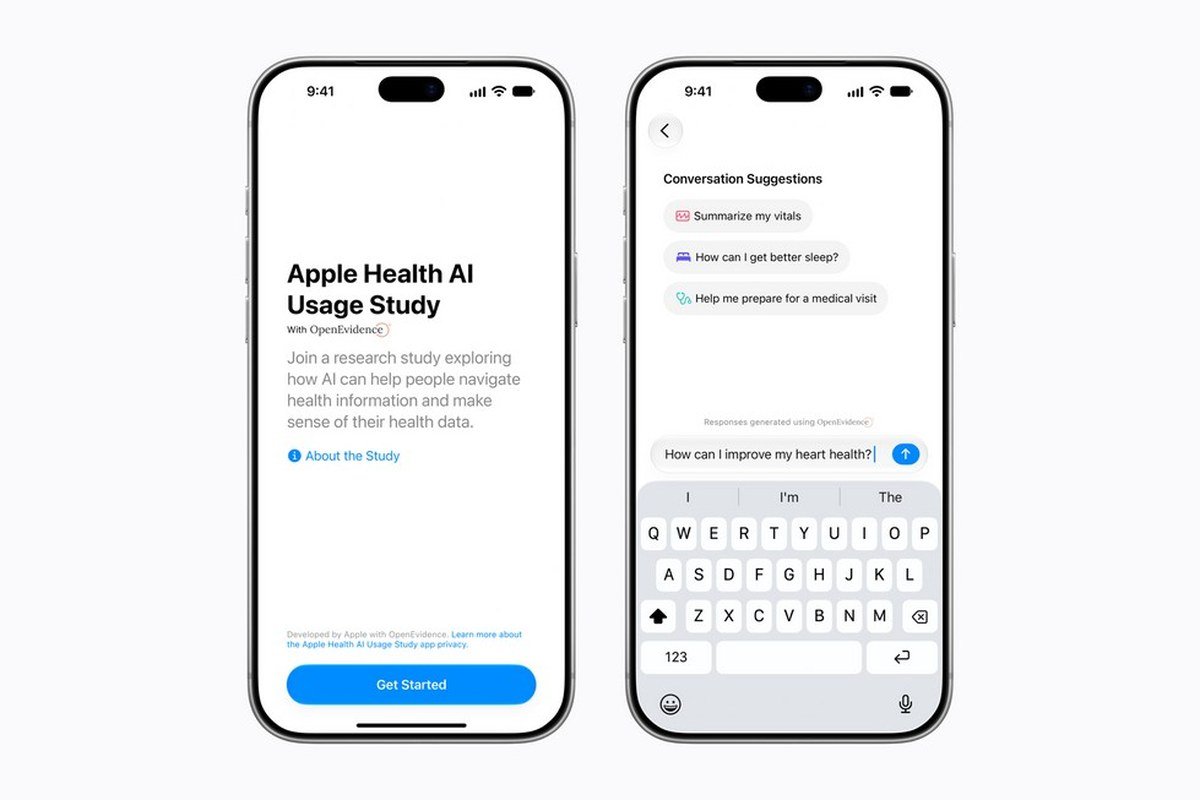
The Apple Health AI Usage Study, conducted with OpenEvidence, a clinical AI platform used by health care professionals, will test what drives user trust, the quality of responses, comprehension, and the everyday health actions people take after asking an AI tool a health question.

Participants will use a study app to ask everyday health questions, explore complex medical information written in approachable language, and see linked, peer-reviewed clinical citations behind each answer. OpenEvidence draws on medical information from sources including The New England Journal of Medicine, the Journal of the American Medical Association, and Nature.
Participants can also choose to share HealthKit data, such as resting heart rate, activity, sleep, or lab results, to explore how personal data affects the relevance and understanding of the answers they receive.
“At Apple, we believe responsible innovation starts with scientific rigor and clinical grounding. Health is deeply personal, and conducting a dedicated research study is the most thoughtful way to understand how people engage with, comprehend, and evaluate health AI in everyday life,” said Sumbul Desai, M.D., Apple’s vice president of Health and Fitness.
“Patients and clinicians are both turning to AI, but the tools they use are being built and tested in separate worlds,” said Robert M. Wachter, M.D., professor and chair of the Department of Medicine at the University of California, San Francisco. “When patients and doctors draw on versions of the same trustworthy tools, patients arrive prepared, conversations improve, and next steps happen seamlessly.”
The study is open to up to 200,000 eligible participants age 21 and older across the United States. To join, participants must have an Apple Intelligence-enabled iPhone, iPhone 15 Pro or later, running iOS 26 or later.
Apple says the study is designed with privacy protections, transparency, and clinical guardrails, and study data will not be used to train AI models. Participants keep control over whether to share HealthKit metrics or survey responses, and the study app has safety guardrails meant to detect certain concerning questions and suggest a follow-up with a provider.
The study app is not meant to diagnose or treat any condition, or to replace the advice of medical professionals, Apple says.
For Surrey iPhone users, the study matters even though enrolment is limited to the United States. Health AI tools are already part of everyday life for patients and doctors here, and the findings will shape how Apple designs health features on the iPhones Surrey residents already carry, including how clearly those tools explain medical information and when they point people back to a doctor.
(Source: Apple Newsroom, November 15, 2026)