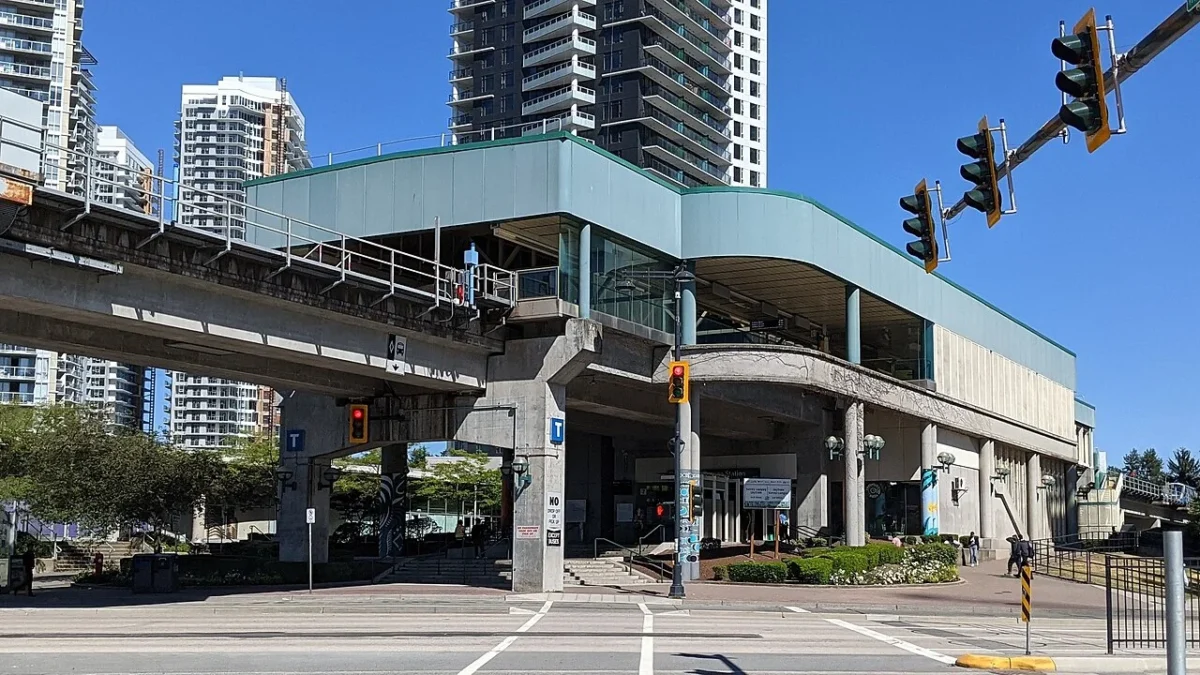
SURREY, B.C. - Nineteen minutes apart on Tuesday morning, the Conservative Party of BC and the BC NDP both promised to bring SkyTrain to Newton, Surrey’s largest town centre and the community that has waited the longest for rapid transit in this city. Neither promise came with a price tag for the project itself, a list of stations, or an opening date. With voting day set for Saturday, October 24, here is what each party actually put on paper, what the words do and do not commit a future government to, and what it would take to turn either promise into trains.
🗓️ What happened on Tuesday
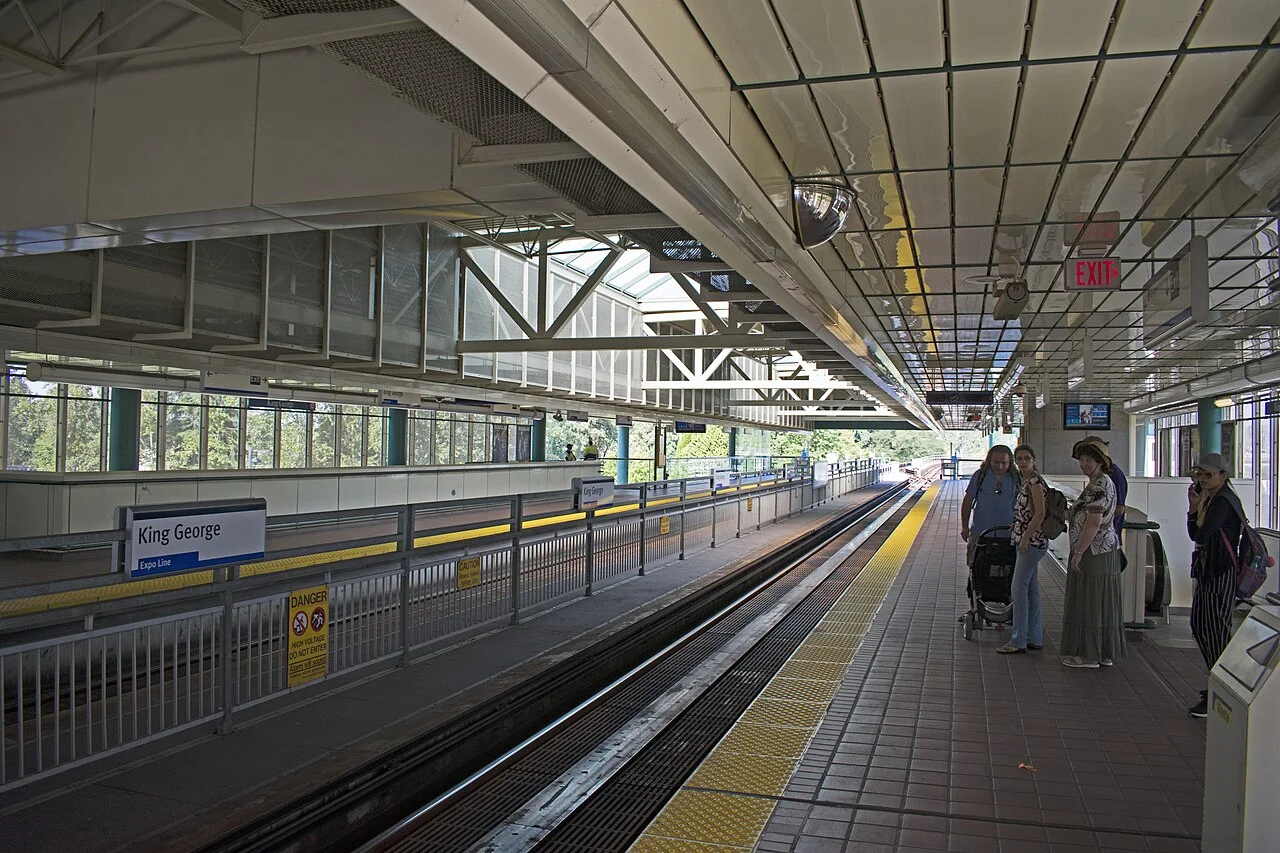
The Conservatives moved first. At 8:45 a.m. on October 20, leader Lorne Doerkson announced that a Conservative government would work with the federal government to fund and build rapid transit along King George Boulevard to Newton Town Centre.
“Families in Newton shouldn’t have to keep waiting on promises that never get delivered,” Doerkson said in the release. “This community has been patient for far too long. I’m committing to this project now, and a Conservative government will build it on time and on budget.”
The release named no dollar figure. It pointed to 2018, when plans for light rail to Newton were scrapped and residents were told rapid transit would still come. Eight years later, the party said, Newton is still waiting.
At 9:04 a.m., 19 minutes later, the BC NDP followed. Leader David Eby promised that a re-elected NDP government “will support” extending SkyTrain from Whalley to Newton along the King George Boulevard corridor, and said the party has earmarked $250 million in its costed platform for a transit expansion to Newton’s neighbourhood.
“Surrey voters have spoken clearly: They want us to get results for them, which includes reliable transit for the rapidly growing Newton community,” Eby said. “The mayor-elect and I worked together to get the SkyTrain to Langley under way, and I’m committed to partnering again to achieve his vision for improved public transportation in this city.”
Speaking to reporters in Kelowna later that day, Eby added that the concrete guideway segments for SkyTrain are already being cast at a factory built for the Surrey-Langley line. “There’s actually a massive factory that’s producing the giant concrete components for these things. It’s already up and running,” he said, arguing the Newton line could save money by not starting from scratch.
🔍 The two promises, side by side
The corridor is the same. Almost everything else differs, starting with the verbs.
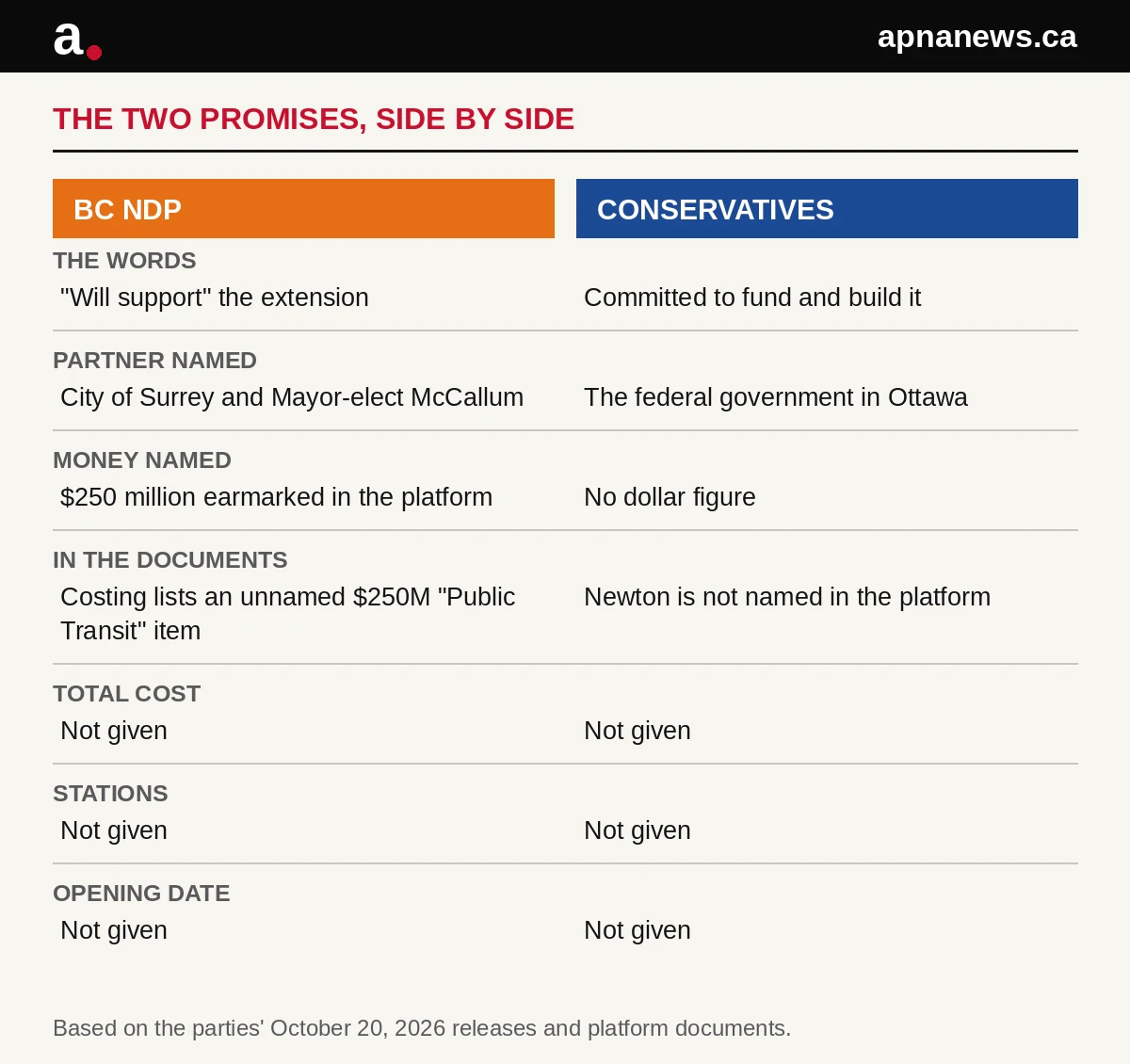
The Conservative promise is a commitment to build, made jointly with Ottawa. The party says a Conservative government will fund and build the extension with the federal government, on time and on budget. What it does not include is money: the Newton extension is not named in the Conservative platform, and no dollar figure was attached to Tuesday’s announcement. The platform supports transit expansion where population and ridership show the need, with capital costs to be set project by project through business cases, shared with federal, municipal and private partners.
The NDP promise is a commitment to support, made jointly with the City of Surrey. Eby named a partner at city hall, mayor-elect Doug McCallum, rather than in Ottawa, and he named a sum: $250 million. The fine print matters here. In the NDP’s own costing document, that $250 million appears as a general “Public Transit” capital item spread across 2026/27 to 2031/32, with no project named beside it. The link between the money and Newton exists in Eby’s campaign statements, not in the costing table itself.
And on the questions a Newton rider would ask first, the two announcements are identical: neither gives a total cost estimate, a route length, station locations, or a construction schedule.
💰 The $250 million question
The NDP’s $250 million started its life as bus money. Just last week, on October 15 in Surrey, Eby pledged the same $250 million toward Bus Rapid Transit (BRT, a rapid bus service running in dedicated lanes) on King George Boulevard, the plan TransLink has been designing for the corridor and Surrey council voted to move into full design in May 2026. On Tuesday, Eby said the allocation could now come to the table for SkyTrain instead, reflecting the wishes of the incoming mayor, who was elected October 17 on a SkyTrain-to-Newton platform, over outgoing mayor Brenda Locke, who championed the BRT.
Eby argues the money gives his promise more substance than the Conservative one, and he accused the Conservatives of promising Newton a SkyTrain without budgeting for it. The counterpoint is scale. A SkyTrain extension would most certainly cost well over a billion dollars, as the Daily Hive noted in its coverage, and the region’s reference point is the Surrey-Langley SkyTrain now under construction: 16 kilometres of elevated line with eight stations, a budget of $5.996 billion, and service expected in late 2029. Against numbers like those, $250 million is a first instalment, not a funding package. Against the BRT’s estimated total cost of about $700 million, the same $250 million is more than a third of the whole project.
🏛️ The mayor-elect has picked a side on wording
McCallum, whose campaign made SkyTrain to Newton a centrepiece, responded to both announcements on Tuesday and drew a sharp line between them.
“This week one party committed to build SkyTrain to Newton, and the other offered a meeting,” he said in a statement issued through the Safe Surrey Coalition. “Newton has been in meetings for years. It needs a commitment, and it needs shovels.”
“A commitment to build is not the same as a willingness to talk,” he added, pointing to Eby’s comments on Sunday, when the premier said he welcomed “that conversation” about what it would take, with the city, Prime Minister Mark Carney, TransLink and the Mayors’ Council at the table.
McCallum said Surrey’s part will be ready the day the new council is sworn in: the city will decide the route down King George Boulevard and issue the permits, as it did for the Langley line. “I have built SkyTrain in this city before, and I know what a yes looks like,” he said. “It is a commitment with a route, a partner in Victoria and Ottawa and a timeline, and that is what the Conservatives have put on paper for Newton.” He added that he will work with whichever government Surrey elects on Saturday.
📍 Why Newton, and why now
Newton is Surrey’s largest town centre, in a city adding roughly a thousand residents a month, and it has no rapid transit. The demand is not theoretical. According to Movement, Metro Vancouver’s transit riders’ organization, the King George Boulevard bus routes, the R1 RapidBus and the 321 and 394, already carry about 27,000 trips every weekday, largely in the same traffic as everyone else. The 321 has gotten 15 per cent slower since 2019, one of the steepest slowdowns in the region, and remains one of its most crowded routes.
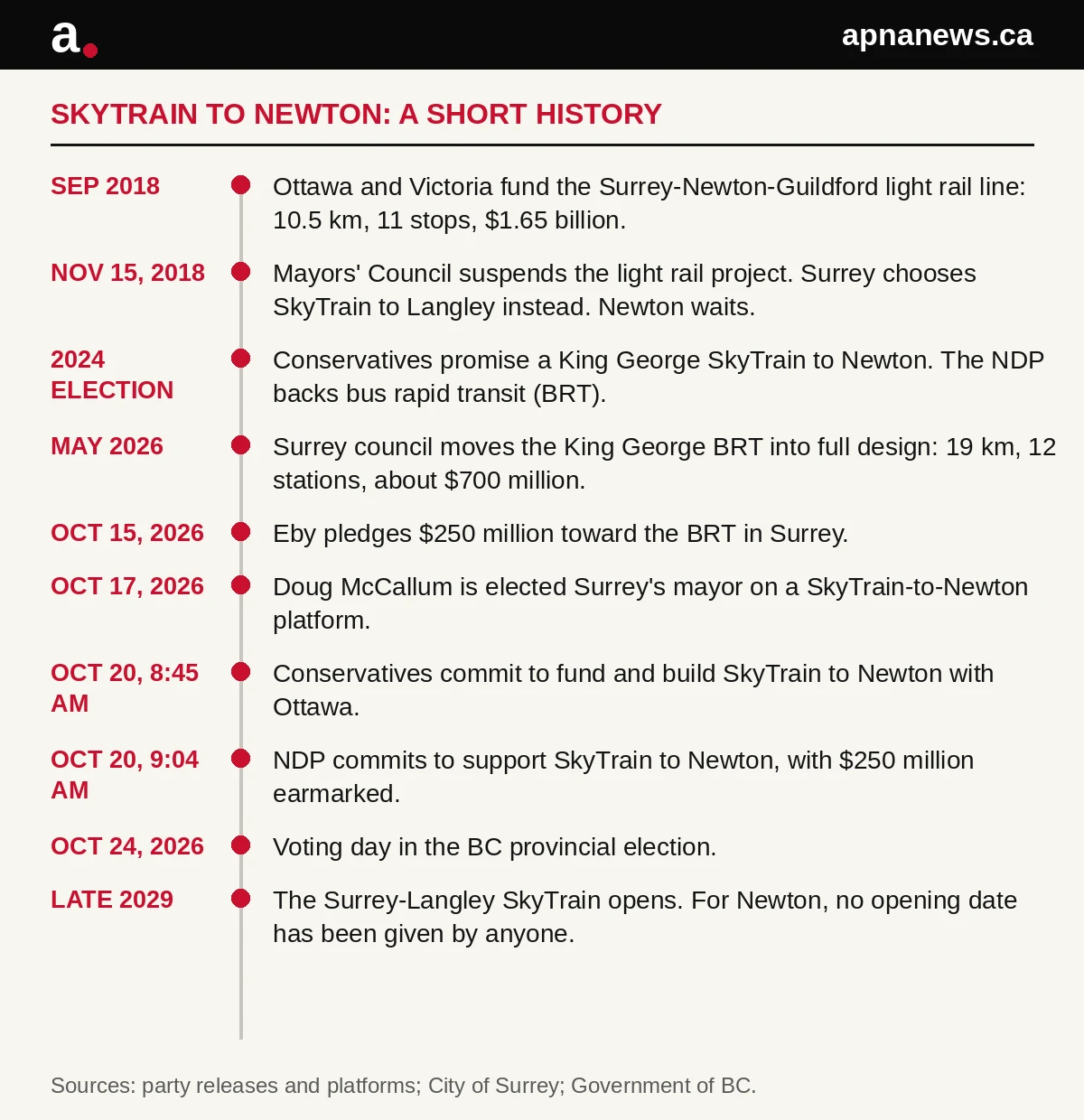
Newton has also been promised this before. In September 2018, the federal and provincial governments funded the Surrey-Newton-Guildford light rail line: 10.5 kilometres at street level, 11 stops, an estimated $1.65 billion. That November, McCallum’s newly elected council asked TransLink to cancel it and build SkyTrain along Fraser Highway to Langley instead. The Mayors’ Council suspended the light rail project on November 15, 2018, and the money and attention went east. The Langley line is now rising along Fraser Highway, and Newton is still on the bus.
Tuesday was not even the first time these parties have split on this corridor. In the 2024 provincial election, the Conservatives also promised a King George Boulevard SkyTrain to Newton, while the NDP backed the BRT. What changed in 2026 is the NDP’s position, and what changed it, by all accounts, is the October 17 municipal result in Surrey.
🚧 What it would actually take to build it
A campaign promise is the first of at least five steps, and the Langley line shows how long the road is. Surrey council chose SkyTrain over light rail in November 2018. The Surrey-Langley SkyTrain opens in late 2029, eleven years later. Movement estimates a Newton SkyTrain would realistically take a decade to deliver. These are the tests any Newton promise still has to pass:
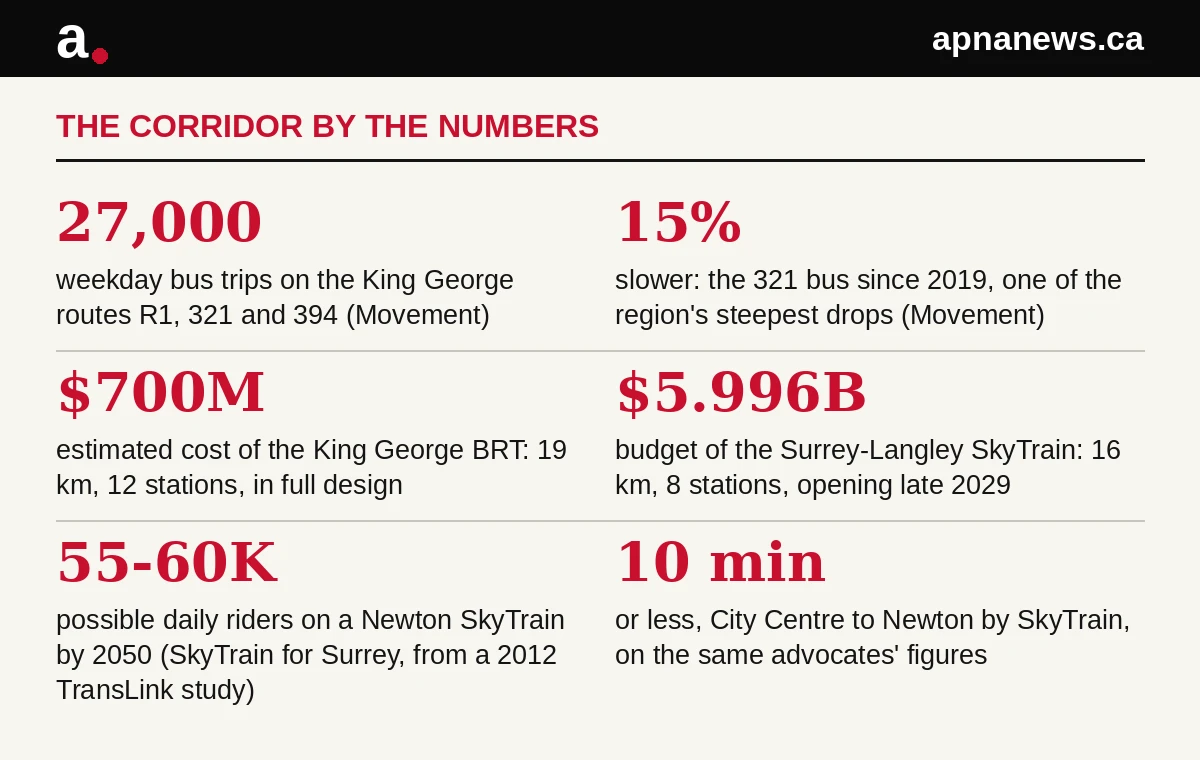
- A business case. No business case for a King George SkyTrain exists. The planning work done on this corridor, years of it, is for the BRT. A SkyTrain business case would set the route, the stations, the ridership case and the first real cost estimate. The advocacy group SkyTrain for Surrey, which welcomed both parties’ commitments on Tuesday, cites a 2012 TransLink study that found a King George SkyTrain could carry 55,000 to 60,000 riders a day by 2050 and cut the City Centre to Newton trip to 10 minutes or less. Those are the advocates’ numbers from an old study, not a current government estimate, which is precisely the gap a business case fills.
- A place in the regional queue. TransLink’s Mayors’ Council decides which rapid transit projects the region advances, and Newton would compete with the Broadway Subway extension to UBC, North Shore rapid transit and other lines for the same federal and provincial dollars.
- A funding agreement. The Langley precedent was funded with $4.4 billion from Victoria and $1.3 billion from Ottawa toward its $5.996 billion budget. Neither party has announced a split for Newton, and no federal commitment to Newton was announced on Tuesday by either party.
- A decision on the BRT. The King George BRT is not a paper plan: it is a 19-kilometre, 12-station line from Surrey City Centre to Semiahmoo Town Centre in South Surrey, in full design since May, with 84 per cent support in TransLink’s public consultation. A Newton SkyTrain covers only the northern part of that corridor. Movement is urging the parties not to trade the near term for the long term: build the BRT within three years as the first phase, they argue, and let it keep running to South Surrey after a SkyTrain opens, rather than leaving Newton riders with another decade of crowded buses while a SkyTrain is planned.
- Money to run it. A new line needs operating funding inside a TransLink system that, Movement notes, faced the threat of deep bus and rail cuts in 2025 and faces another funding crunch in about a year. The riders’ group says three of the four major parties have promised to fix TransLink’s funding model, and the Conservatives are the only one that has not explicitly committed to preventing that fiscal cliff.
❓ Frequently asked questions
Did both parties really promise the same thing?
Both parties promised SkyTrain along King George Boulevard to Newton on October 20, 2026, in releases 19 minutes apart. The Conservatives committed to fund and build it with Ottawa, with no dollar figure. The NDP committed to support it with Surrey, with $250 million earmarked in its platform. Neither named a total cost, stations or an opening date.
How much would SkyTrain to Newton cost?
Nobody running for office has said. No current government estimate exists, because no business case has been done. For scale: the Surrey-Langley SkyTrain, 16 kilometres and eight stations, carries a $5.996 billion budget, and the cancelled 2018 light rail plan for Newton was estimated at $1.65 billion in 2018 dollars. The BRT designed for the same corridor is estimated at about $700 million.
When could SkyTrain to Newton open?
Neither party gave a date. The Langley line took eleven years from council’s 2018 decision to its expected opening in late 2029, and transit advocates estimate a Newton line would realistically take about a decade from commitment to opening.
What happens to the King George Boulevard BRT?
That is undecided, and it is the live question underneath the SkyTrain headlines. The BRT is in full design, would run 19 kilometres from Surrey City Centre through Newton to Semiahmoo Town Centre, and could open years before any SkyTrain. The NDP’s $250 million was pledged to the BRT last week before Eby redirected it toward the SkyTrain discussion on Tuesday. Transit riders’ groups want both: the BRT built now as a first phase, the SkyTrain planned behind it.
What about Guildford?
Guildford was promised rapid transit alongside Newton in the 2018 light rail plan, and neither of Tuesday’s announcements mentions it. Movement is asking the parties to make sure Guildford sees service improvements, not cuts, once Newton rapid transit is built.
Who decides whether it gets built?
Formally, a project this size needs a business case, a place in TransLink’s regional plan approved by the Mayors’ Council, and a funding agreement between the provincial and federal governments. Politically, it starts with whichever party forms government after the October 24 election, and with a Surrey council that says its route and permits will be ready.
The promises are now on the record, from both parties, in the same corridor, in the same words voters can hold a government to. What neither party has yet put on the record is a cost, a station, or a date. Those details, as Newton has learned over eight years of waiting, are where transit promises either become projects or become history.
“This explainer is based on the parties’ October 20, 2026 releases and public remarks. Apna News will update it if either campaign releases costing, station or timeline details.”
Sources: The Canadian Press and Surrey Now-Leader reports of October 20, 2026 on the Conservative Party of BC and BC NDP releases and leader remarks; Safe Surrey Coalition statement from mayor-elect Doug McCallum, October 20, 2026; City of Surrey, Council approves next stage of King George Boulevard BRT, May 12, 2026; Government of British Columbia, Surrey Langley SkyTrain project status report, May 2026; Movement: Metro Vancouver Transit Riders, release of October 20, 2026; SkyTrain for Surrey, release of October 20, 2026 and 2024 voters’ guide.
Advertisements
Add Apna News as a trusted source on Google
Star Apna News in your Google preferences so Surrey election results, candidate profiles and local news appear first in your search and Discover feeds.